

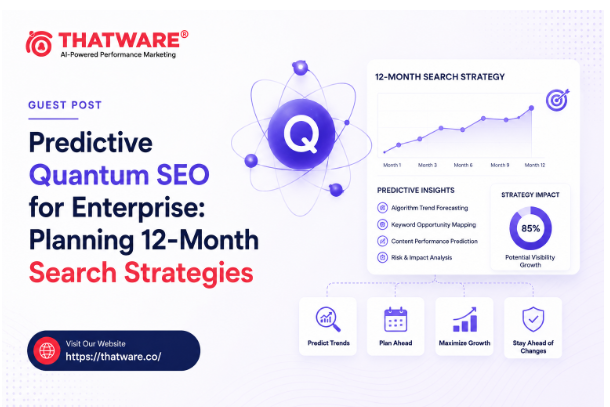
Enterprise SEO strategy has a planning problem. The tools available for search strategy planning are fundamentally backward-looking — they tell you where search demand is today, what your rankings are now, and what your competitors are doing currently. Building a 12-month strategy from these inputs is like navigating by looking through the rearview mirror.
This is fine when search landscapes are relatively stable. It’s a serious liability when they’re not. And right now, they aren’t. AI-generated search results are reshaping the SERP. New regulatory environments are creating new search demand. Technology shifts are changing how people frame queries. Industries that seemed stable in search terms are seeing query landscape disruptions that historical data simply didn’t predict.
Predictive quantum SEO for enterprise solves the planning problem by providing a forward-looking analytical framework — one that uses quantum-inspired probabilistic modeling to generate actionable forecasts of where search demand is heading, not just where it is.
Why 12-Month Enterprise SEO Planning Requires Prediction
Enterprise SEO strategy operates at a fundamentally different planning horizon than SMB SEO. A small business can adjust its SEO strategy quarterly or even monthly with relatively low overhead. Pivoting is easy when you have a small content library and a nimble team.
Enterprise SEO involves multimillion-dollar content investments, teams of 20–100+ people, technology infrastructure commitments, and organizational alignment processes that take months. A content strategy built in Q4 for the following year needs to remain relevant through Q4 of that year — even though the search landscape will look different in 12 months than it does today.
This requires predictive capability. Not prediction as in “I know exactly what will happen” — that’s impossible. Prediction as in “I can identify the probability-weighted range of scenarios that are most likely to occur and build a strategy robust enough to succeed across that range.”
This is precisely what quantum-inspired probabilistic modeling provides: not point estimates of the future, but probability distributions over possible futures, with strategy built to perform well across the realistic distribution rather than optimized for a single assumed scenario.
The Predictive Quantum SEO Planning Framework
Predictive Quantum SEO for enterprise planning operates in four phases:
Phase 1: Landscape scanning and scenario modeling — Systematic identification of the major forces that will shape the search landscape in your industry over the planning period. These include: expected regulatory changes, technology shifts affecting your category, major product or service category evolutions, competitive dynamic changes, and platform/algorithm developments that will affect SERP structures.
For each identified force, the model develops probabilistic scenarios: if this regulatory change occurs, what happens to search demand in these query clusters? If this technology trend accelerates, which content areas become more or less valuable? The output is a set of weighted scenarios representing the most likely configurations of your future search landscape.
Phase 2: Strategy robustness testing — Each candidate strategic direction is tested against the scenario distribution. Which investments produce good outcomes across most scenarios? Which are highly scenario-dependent (good returns in some scenarios, poor in others)? A robust strategy is one that generates acceptable returns across the full distribution, not just in the most likely single scenario.
Phase 3: Priority sequencing with optionality — Investments are sequenced to preserve strategic optionality. Early-period investments are in areas with high value across most scenarios. Later-period investments include scenario-conditional commitments — planned investments that will be made only if specific signals confirm particular scenarios are materializing.
Phase 4: Monitoring and pivot triggers — The plan includes explicit monitoring protocols and pivot triggers: specific signals that, if observed, indicate a scenario shift requiring strategy adjustment. These turn the 12-month plan from a static document into a living strategy that adapts as the landscape clarifies.
Identifying Leading Indicators for Enterprise Planning
The practical value of predictive quantum SEO is only as good as the quality of its forward-looking signals. For enterprise planning, the most useful leading indicators operate on longer time horizons than the trend signals used in news SEO.
Regulatory and policy pipeline monitoring — Regulatory changes often move through predictable pipeline stages (consultation, draft, comment, finalization, implementation) that can be tracked 6–18 months before they affect search behavior. Enterprise SEO teams that monitor the regulatory pipeline in their industry can anticipate search demand shifts well in advance.
Academic and research publication trends — Research that will influence practice and consumer knowledge typically appears in academic publications 1–3 years before it materially affects search behavior. Systematic monitoring of relevant journals and research databases provides extremely long-horizon signals.
Technology adoption curves — New technologies create new search demand as they move through adoption stages. Identifying which technologies are entering the early majority adoption phase in your industry provides reliable 12–24 month search demand forecasts.
Competitive intelligence on product roadmaps — Competitors’ product and service roadmaps — often partially visible through job postings, conference talks, patent filings, and developer community discussions — provide signals about where they’re investing, which in turn affects the competitive search landscape they’ll be creating.
Resource Planning with Probabilistic ROI Modeling
One of the most practical applications of predictive quantum SEO for enterprise is probabilistic ROI modeling — replacing deterministic content investment projections with probability-weighted expected value calculations.
Traditional SEO content planning asks: “If we invest X in this content cluster, what ranking and traffic outcome can we expect?” This produces a point estimate that’s typically wrong in both directions — sometimes better, often worse — and gives no guidance on how much uncertainty surrounds the projection.
Predictive quantum SEO asks: “Across the distribution of plausible future scenarios, what is the probability distribution of outcomes from this content investment?” This produces a range — expected value, best case, base case, downside case — that enables much more informed budget allocation decisions.
Quantum SEO consulting teams build these probabilistic models using historical performance data from comparable content investments, competitive landscape analysis, and scenario-weighted demand forecasting. The output allows enterprise SEO teams to present investment cases to CFOs and CMOs in terms of expected value and risk profile rather than single-point projections that rarely materialize exactly as forecast.
Building Organizational Alignment Around Predictive SEO
Enterprise SEO planning isn’t just an analytical challenge — it’s an organizational challenge. Getting a 12-month strategy approved, resourced, and actually executed requires alignment across marketing leadership, content, product, engineering, and finance teams. Each of these functions has different planning cycles, different metrics, and different risk tolerances.
Predictive quantum SEO supports organizational alignment by providing:
Scenario-based communication — Presenting the strategy as “here’s what we’ll do under different scenarios” rather than “here’s the plan” reduces resistance by acknowledging uncertainty honestly rather than projecting false confidence.
Leading indicator dashboards — Sharing the monitoring framework and early signal data with leadership creates organizational literacy around the predictive signals. When leadership can see the leading indicators evolving, they’re more prepared for and aligned with strategy pivots when triggers are met.
Staged investment structures — Breaking the 12-month investment into staged commitments with explicit decision points gives finance teams the control checkpoints they need while preserving the strategic continuity that SEO compounding requires.
Cross-functional content roadmaps — Translating the SEO content strategy into content roadmaps that include product team inputs (new product launch timelines), PR team inputs (planned announcements), and executive thought leadership inputs (conference talks and publications) creates alignment across functions and ensures SEO strategy integrates with rather than conflicts with other content-generating activities.
The Compounding Returns Argument
The business case for investing in enterprise predictive quantum SEO planning comes down to compounding.
Organic search authority compounds. Content investments made this year contribute to topical authority that makes next year’s content investments more effective. A 12-month plan that’s built with predictive intelligence — investing ahead of demand shifts, building authority in areas before they become competitive, and making sequential investments that reinforce each other — compounds more effectively than a reactive plan that chases current demand.
The difference between a strategically planned, prediction-informed content ecosystem and a reactively built one isn’t linear — it’s exponential over a 3–5 year horizon. Enterprise organizations that make the investment in predictive quantum SEO planning are building compounding structural advantages that are genuinely hard to replicate quickly, regardless of how much money a competitor decides to throw at the problem later.
That’s the real argument for planning with prediction rather than with rearview mirrors.